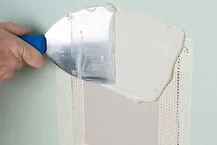
Older Providence homes have plaster, newer ones and remodeled rooms have drywall, and many have both. We patch holes, tape cracks that keep coming back, repair water-damaged areas and prime every repair so it does not show through the paint.
Wall repair in Providence means plaster as often as drywall. Houses built before the 1940s have plaster on wood lath. Later houses, additions, finished attics and remodeled kitchens have drywall. Many homes have both, sometimes on the same wall where an old doorway was closed. The repair has to suit the wall it is in. We look at the damage, press on the area to see if it is solid, and tell you whether it needs a patch, a skim coat or a new section.
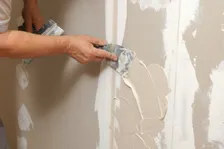
Small holes and dents are filled and sanded. Larger holes get a new piece of drywall, taped and coated in thin layers so the edge does not show. Plaster that has come loose from the lath is refastened or cut out and filled. Cracks that return every winter are taped, not just filled. Water damage is repaired only after the leak is fixed and the wall is dry. Each coat of compound needs time to dry, so a repair often takes more than one visit.
A patch is finished when it is primed. Bare compound soaks up paint differently from the wall around it and shows as a dull spot unless it is sealed first. On old textured or sand-finish plaster, matching the surface takes extra care, and a close match is the honest goal. Sanding old painted plaster in a pre-1978 house is done with lead in mind. The quote covers the repair, primer and, if you want it, repainting the whole wall.
Drywall repair in Providence: common questions
Can you repair plaster, or does it have to be replaced with drywall?
Most plaster can be repaired. Cracks are taped, loose areas are refastened and missing sections are filled. Replacement with drywall makes sense only where large areas have let go of the lath.
Why does the same crack keep coming back?
Because the house moves a little as it heats, cools and dries out through the year. Filler alone cannot hold against that. Tape bedded in compound over the crack spreads the movement and usually keeps it closed.
Will I be able to see the patch after painting?
It should not stand out if it is feathered wide, primed and the whole wall is painted corner to corner. Touching up only the patch often shows. Heavy texture is harder to match exactly, and we say so before we start.
How it works
- Free estimate: Call, text or book online. We walk the job and measure.
- Written quote: Prep, paint and price in writing.
- Prep & protect: We cover floors and furniture, repair and prime surfaces.
- Paint & walk-through: Two coats, clean lines, full clean-up and a final walk-through.